


Crime and Punishment
Updated: 3 hours ago
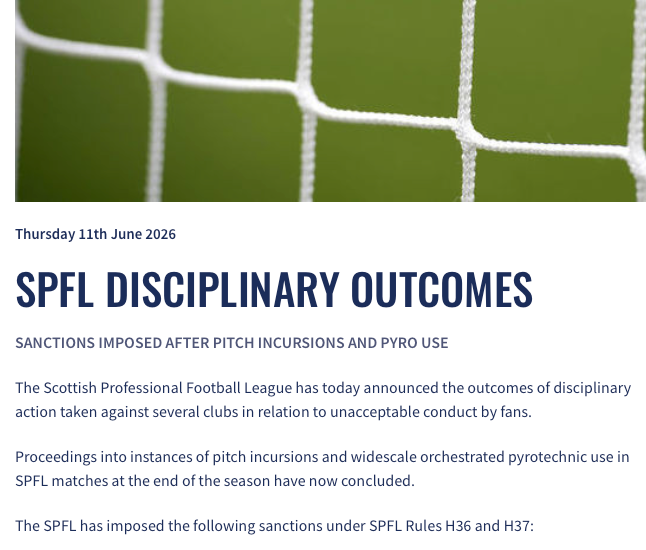
The events at Ibrox last season, when the fans of both clubs were on the pitch, seemingly not to exchange fraternal greetings but for other, less desirable purposes, has led to the football authorities issuing punishments (aka ‘sanctions’) to Rangers and Celtic. In addition, we’ve seen Motherwell fined not much under €100,000 for the various misdemeanours of their fans at home and in Europe. Aberdeen too have had ‘issues’ with their fans’ behaviour at Kilmarnock recently, leading to another round of sanctions being imposed by the SPFL which will cost the club both money and support at their forthcoming League Cup semi-final.
Now, both Celtic and Rangers are appealing against the closed-doors sanction imposed upon them. The fact that 43 people have been arrested in connection with that match suggests that something clearly went wrong that day. The appeal hearing will take place on 26th October.
As the SFU knows from our contact with Hampden, and contrary to what many fans might think, the football authorities do care deeply about making the game safe for all fans and have taken more action that many might realise. The reality is that sanctions on clubs for the antisocial behaviour of their fans have had results, especially around pyro use in grounds, which has decreased quite a bit in the last few seasons.
While welcoming the SFA/SPFL stance, there is, however, in our opinion, a problem; namely that their focus is principally on what happens inside grounds. A reduction in pyro use inside stadiums has led to more fans, invariably Ultras’ groups, marching up to the game with pyros wreathing the surrounding air with multi-coloured smoke. These flares are no less hot, full of toxins and potentially dangerous for being outside a ground. Without the game, there would be far less reason, or opportunity, for pyros to be lit or fans to fight in the surrounding streets.

The SFU view on Ultras is quite simple. No pyros, no fighting, no problem. Without those two antisocial elements, the gangs of Ultras do bring noise and fervour, enhancing the atmosphere at many matches. Most fans welcome this. However, to judge by social media, most non-Old Firm fans also welcome the imposition of more strict punishments on Celtic and Rangers and also on other clubs whose fans cross the line. In fact, as we’re seeing with the Manchester City debacle south of the border, the main complaint is that the football authorities haven’t gone far enough. The punishment of having your ground closed for a Cup match and £100,000 payment being made to the opposition on that day is, in the view not just of fans but also of one former club owner we know, not sufficient. If, for example, the visitors were one of the bigger teams, say Hearts or Aberdeen, that £100,000 may well be less than the half-share of the gate they would normally have received for a Cup match. So, what should the punishments be if they are to fit the crimes? Here’s our suggestion, with a preamble that sets out the thinking behind it.
Firstly, if you ban all fans then those of the opposing club are being punished for something that’s not their fault. Sure, their club gets £100 grand, but, as noted above, in many cases the amount of money they would have received is far more than that. Moreover, the offending club that has had its ground closed does not have a police/stewarding/catering/cleaning bill to pay, although on the other side of the ledger they lose a lot of revenue from not being able to sell any hospitality, pies and programmes. In addition, the opposing players have to play in a sterile atmosphere, with none of their own fans to support them or cheer any goals they might score. So, how do we create a punishment that is a deterrent to the club whose fans have transgressed but not to the opposing club that has to play in an empty stadium, without any of their fans being able to watch and give support to their side?
Our idea is that the club receiving the punishment is not given any away tickets for its next two matches, whether League or in the Cups (not time-limited, so this can carry over to another season if necessary). This means that the home clubs still have their own supporters to cheer them on, which gives them an advantage as the offending (away) team will not have the benefit of their supporters doing likewise. Ah, but what about the lost revenue from the away fans that would normally accrue to the home club in a league game? The answer here is simple: for League matches, you take the average away gate attendance and associated revenue for the previous three home League games against the offending club and that is paid by them to the home club to compensate. This would also apply for Cup matches, but with half the gate from the offending club’s last three away Cup matches being paid to the home club. This means that, unlike the arbitrary sum of £100,000, the ‘fine’ actually starts to match reality. One or two small clubs might get a bonus, but that’s as nothing compared to the impact on the offending club.
There is, of course, the argument that this affects the decent majority of fans from the offending club, who would be denied the opportunity to see their club play for two away games. Sorry, but punishment means doing things that those on the receiving end don’t like, and our view is that the majority of fans would very quickly apply massive peer pressure on those other fans of their club who are prone to antisocial behaviour to toe the line. Moreover, the message that would come out from the hierarchy of the offending club(s) would be unambiguous. They certainly do not want their club to be at a disadvantage in an away game, both in terms of support (or rather lack of it) or finance, with the fine paid to the home club having an obvious effect on the offending club’s bottom line. Consequently, the groups of fans who tend to be at the forefront of any antisocial behaviour, would be leant on to rein it in or face bans from their own stadiums, as has happened recently with Hibs’ Ultras.
Another potential problem is that away fans will buy tickets for the home areas of the ground. That's quite likely to happen, but again, a suitable deterrent can be applied. If any away fans are found in the home stands at such a match, they should have a Football Banning Order applied to them.
The football authorities will argue, rightly to a large extent, that the actions they have taken are working. So far, so good, but in the increasingly polarised society we live in, where social media can show videos of (possibly pre-arranged?) fights between Old Firm fans, it is, sadly, quite likely that we’re going to see the need for more punishments to fit the crimes that some football fans are always going to commit. Education, yes, that’s part of the answer (and it’s probably cheaper than the fines outlined here), but the SFA and SPFL have now set a marker and it is important that they don’t retreat from it. We have seen record crowds in Scotland for some years now, but there are still many unsold seats in most grounds. Creating a safe, but still vibrant atmosphere is possible, so long as the clubs, authorities and the majority of fans are willing to act together to do so. And part of that is ensuring that if there is any crime then it is punished in a constructive way that doesn’t affect those who are not responsible for it. We think our idea might be the start of a conversation to achieve that goal…


Comments